Long Story Short
Everything You Need to Know About Long Running for Your First Half or Marathon block
Over the last two years I’ve gone through five marathon training blocks, so it’s fair to say there has been a lottttt of long running in there. Thankfully, I’ve learnt a fair bit about what actually makes a long run useful; they've gone from the run I’d dread every Sunday to now my favourite part of my training week and here is why.
So, long runs are probably one of the first things people think about when they picture half marathon or marathon training. The big Sunday run, the session that seems to carry a lot of importance purely because it has the biggest number attached to it.
And yes, especially when you’re newer to running, building the distance each week might be exactly what your long run needs. But “run further than last week” can’t be the only way you progress forever.
A good long run builds endurance, gets your legs used to spending more time running and, later in a training block, can be used to practise fuelling, pacing and race-specific effort. But not every long run needs to do all of those things at once.
Sometimes the best long run is simply 90 minutes easy. Sometimes it’s a progression. Sometimes there are chunks of marathon pace buried inside it.
The important bit is knowing what the run is actually there to do.

Two Happy Girls After Manchester Marathon 2025
Progressing your long run doesn’t just mean making it longer
When I first started running, my approach was pretty simple: run further than I did last time. I went from 5Ks to half-marathon distances fairly quickly, and not long after starting running I decided a 32K run out of town with two gels and no water sounded like a great idea. I kept getting lost, waited until I felt absolutely awful before taking any fuel and eventually ended up sitting on a kerb with my head between my knees trying not to be sick lol.
Back then, if I had covered a new distance, I considered it a good long run regardless of what state I was in afterwards but now that has to look differentley. Sometimes progression is simply doing the same distance and handling it better. Maybe 16K used to wipe you out for the afternoon and now you finish feeling like you could have carried on. Maybe you recover quicker the following day. Maybe your pace stays steadier towards the end. Those things matter!!
Once you’re coping well with the current workload, you can extend the distance or start adding more structure. What I generally don’t want is someone making the run significantly longer and harder every single week. Your fitness can improve fairly quickly, but your body still need time to adapt to the extra training load. I became much more aware of that after dealing with an Achilles issue during my first attempt at marathon training. Injuries very rarely have one cause, but it definitely made me think more about whether my body was ready for the work I was asking it to do.
Completing the session is only useful if you can recover and keep training afterwards!

Getting Ready to Run my First Marathon (biceps bigger than my training block!)
Long runs aren’t always easy
Most runners still need plenty of straightforward, controlled long running. You absolutely do not need to turn every Sunday into a workout. But as you become more experienced, adding structure to some long runs can make them much more specific to what you’re training for.
That might mean:
starting easy and gradually increasing the effort
finishing with a steady section
adding blocks at race pace
alternating harder and easier sections within the run
The difference is that the harder running is there for a reason, rather than accidentally turning the whole thing into a race. One of the toughest long runs I’ve done was 32K around a track in torrential rain, alternating roughly 1K hard with 1K easy. And I’d forgotten to charge my AirPods!!! So that was 32K, around a track, in pouring rain, with just my own thoughts :)))
It was horrible, but also a huge confidence boost. By that point in my training, the question wasn’t really can I cover 32K? anymore. It was can I still run well within 32K? Obviously, the lesson here is not that everyone should immediately go and run 80 laps of a track. Definitely don’t, your hips won’t thank you for it!
Race specific long runs can then gradually become more demanding as the block develops. I remember the first time I did 5K at marathon pace and thinking, woweee, another 37K of this on race day then.Later in training, I was doing runs around much longer runs with significantly increasing marathon pace, and that effort had started feeling much more familiar.
Then one of the final big runs of a more recent marathon block was 34K with large sections around 4:48/km marathon pace. On paper it looked tough to me but I ran it with a friend and somehow we finished almost confused by how smooth it had felt. That was probably more reassuring than dragging myself through a helllish run. The point of the block was to make that pace sustainable, and by the end I could run it deep into a long run without it feeling horrid.
That’s what good race-specific training should eventually do: make race day feel familiar and less daunting.

Me, Maurten & A lot of time with that Track
What should you eat on race morning?
That original 32K disaster also taught me another fairly important lesson: don’t wait until you feel awful to start fuelling. For longer endurance sessions, you want to be taking carbs while you’re still running well rather than waiting until your energy levels are already on the floor. These days, bigger marathon long runs are an opportunity to practise the whole routine.
What am I eating beforehand?
Which gels am I using?
How often am I taking them?
Can I still tolerate them a few hours in?
And do I still like that flavour by gel number five, or does the thought of another one make me want to throw up?
I’ve covered fuelling properly elsewhere, so I won’t turn this into another fuelling article. The main point is that race day shouldn’t be the first time you test your race day strategy.
My Message to Lily Pre Manchester Marathon 2025
So how long should your long run actually be?
There isn’t one magic distance that suddenly makes something a “proper” long run. It depends on what you’re training for, how often you run, your current mileage, training history, pace and how well you recover.
Sometimes prescribing long runs by time instead of distance makes more sense too, particularly for newer runners. Twenty kilometres could be a very different training load for someone running it in under two hours versus someone who will be out there for closer to three.
This is why I'm not a huge fan of arbitrary rules like every week add X kilometres. I'd rather see someone build gradually, repeat distances when needed, have easier weeks and progress again once the current workload feels manageable. And if your long run is getting so big that it takes several days to recover from every single week, that's worth paying attention to.
A good long run contributes to your training. It shouldn't continually sabotage the rest of it.
For marathon runners I coach, I generally like to build towards at least one long run around 32K before race day, where their training history and injury risk allow for it.
Not because 32K has magical properties. It’s just long enough to give you a really useful rehearsal of what the marathon will eventually demand: significant time on your feet, fuelling repeatedly, controlling your effort when you’re tired and learning what happens to your body several hours into a run.
There’s a confidence element too. Going into race day knowing you’ve already covered 32K makes the full distance feel a little less unknown
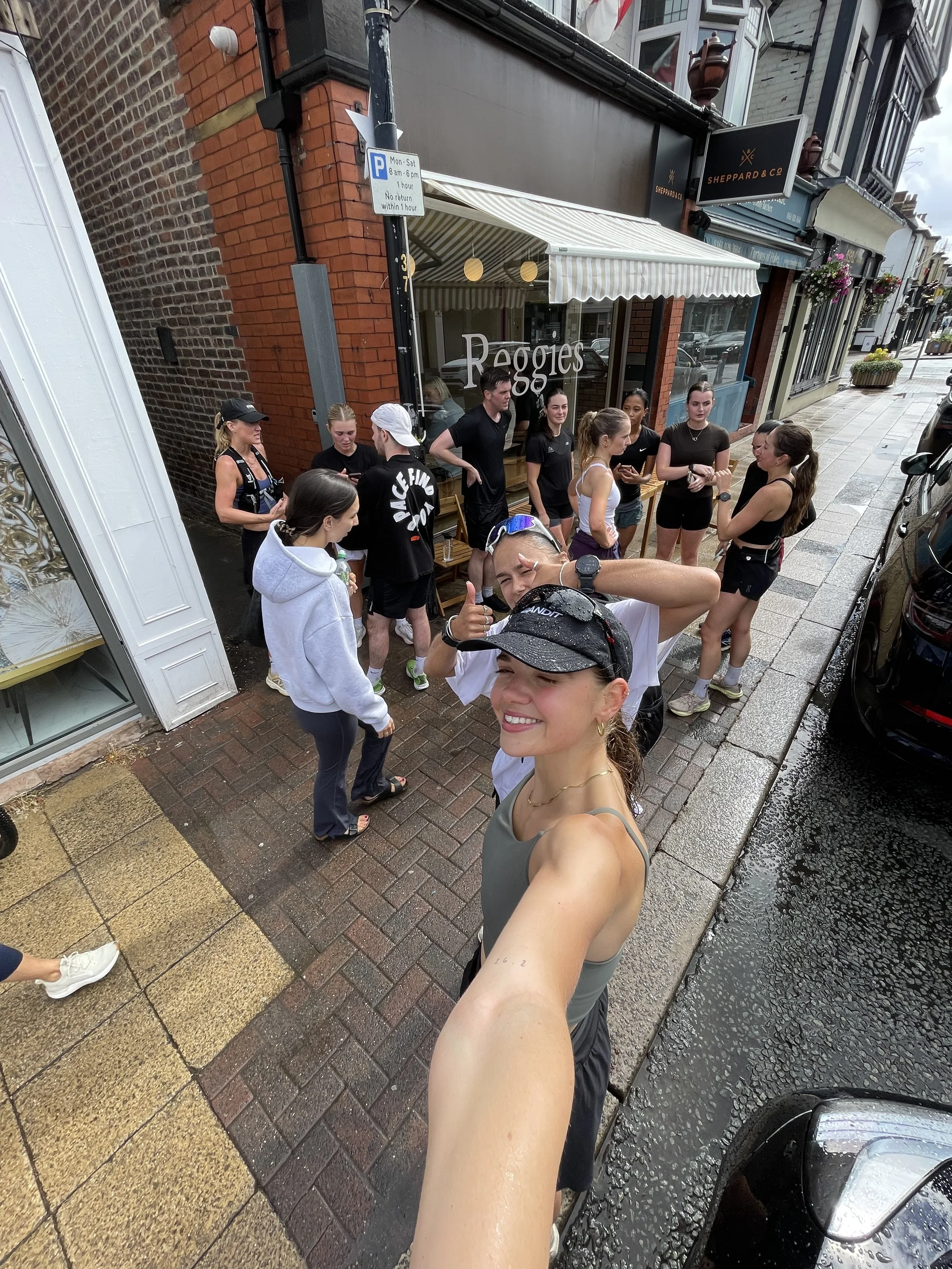
Group Sunday Long Run :)
And long runs are just better with friends
Not particularly scientific, but important. There’s something very nice about setting off for a long run with other people even when everyone has completely different training to do.
One person might have 30K. Someone else has 24K. Someone might disappear off to do marathon-pace work before eventually reappearing. But you’re all out getting your own bit of work done.
Some of my favourite long run mornings are like that, setting off together, doing whatever session you individually need to do, then meeting back up afterwards for the coffee and pastry (best bit)
When marathon training means spending a significant chunk of your weekend running, it helps if it’s something you actually enjoy.
So to sum up: long runs have gone from “let’s see how far I can get” to probably being the bread and butter of my training.Sometimes they’re completely easy. Sometimes they contain marathon-pace work. Sometimes they involve a lot of time going round and round a track.
But the distance alone isn’t what makes the session useful.
A good long run has a purpose, progresses at a rate you can actually absorb and leaves you able to keep training.
The goal isn’t to make every long run your biggest one yet, but to gradually make distances and paces that once felt huge feel completely normal.